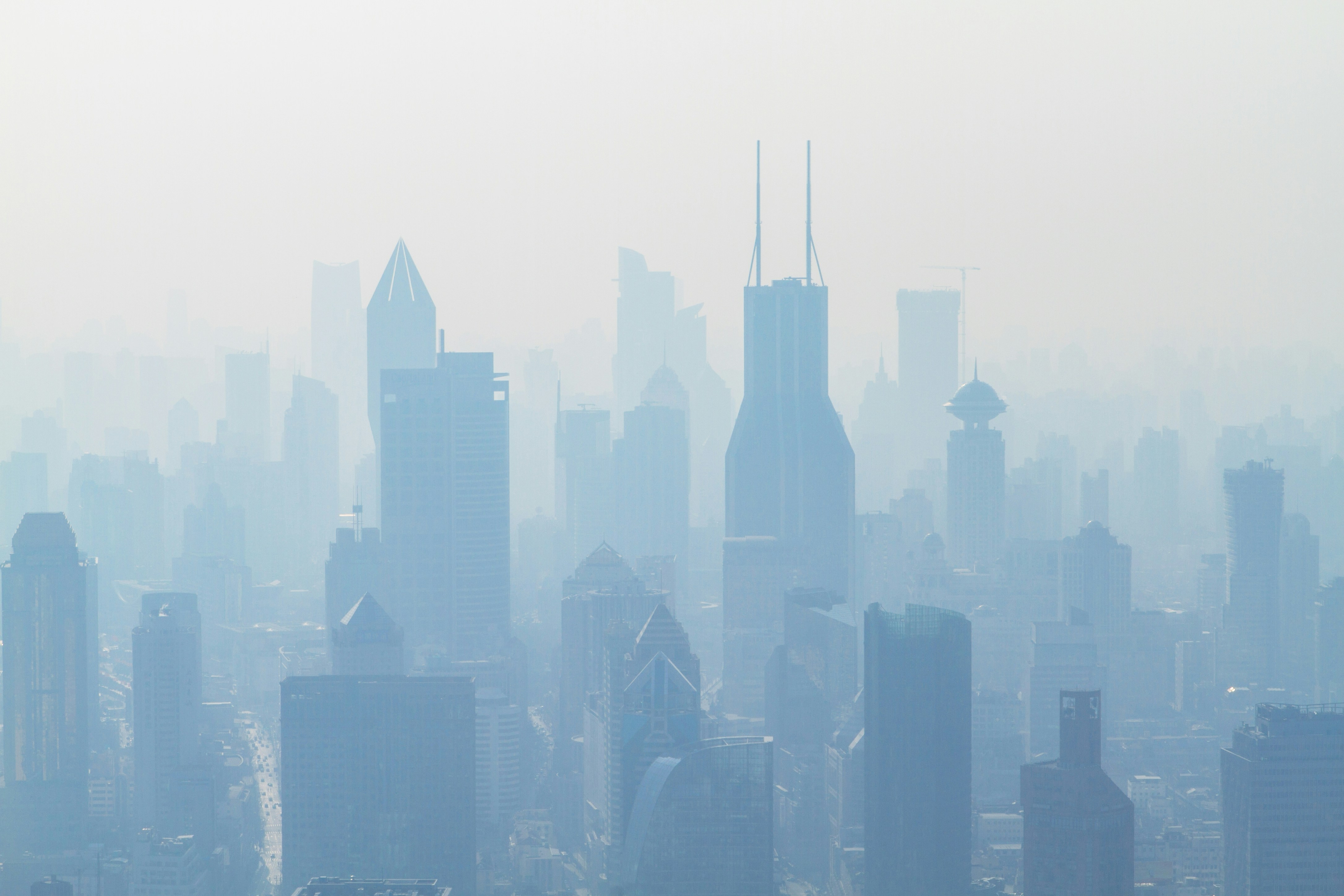
A three-stage program: dispersion modeling baseline → multi-station AQMS deployment → live Air Digital Twin. Your operators and the regulator see pollutant dispersion in near real-time.
Under PermenLHK No. 15/2019, Indonesian industrial estates must monitor ambient air quality at multiple locations, not just one. Yet most estates rely on a single AQMS station or periodic manual sampling that can't capture spatial variability or predict dispersion patterns.
"Your estate is 500 hectares. One station is a pinprick."
ISPU (Indeks Standar Pencemaran Udara) is Indonesia's ambient air quality index, calculated from PM2.5, PM10, SO₂, NO₂, O₃, and CO concentrations. Industrial estates are required to monitor these parameters at multiple locations, not just a single reference point.
MUSA's Air Quality Monitoring is a three-stage program. First, we run a dispersion modeling study using Gaussian plume models and local meteorological data to establish baselines and identify optimal AQMS station locations. Second, we install a network of reference-grade or beta-attenuation AQMS stations across the estate. Third, all feeds converge into MUSA View as a live Air Digital Twin 3D dispersion maps, wind roses, hotspot identification, and automated ISPU reporting.
The result: you don't just know what's happening right now. You can predict what's coming, and prove compliance at any point in time.
Fine particulate matter, the most health-critical ISPU parameter. Beta-attenuation or oscillating microbalance.
Coarse particulate matter, resuspended dust, construction fugitives, stack fallout.
Sulfur dioxide, from high-sulfur fuel combustion. uv fluorescence analyser.
Nitrogen dioxide, traffic and combustion indicator. Chemiluminescence detection.
Ground-level ozone, photochemical product of NOₓ and VOCs. UV photometry.
Carbon monoxide, incomplete combustion indicator. Gas filter correlation IR.
Dispersion driver, essential for interpreting every concentration reading.
Atmospheric conditions that affect pollutant chemistry and sensor performance.
Pressure corrections for standard-condition concentration reporting.
Spatial coverage across your estate, not just a single reference point.
Predict pollutant impacts before they happen, scenario planning, not just observation.
3D visualization of pollutant dispersion across your estate in near real-time.
Get alerted before air quality degrades, not after the monthly review.
Rollup view across all AQMS nodes in MUSA View, estate-wide in one screen.
Ambient air data feeds directly into your GRI and PROPER submission.
Ambient Air Quality Standards require monitoring of PM2.5, PM10, SO₂, NO₂, O₃, and CO. Industrial estates must demonstrate compliance at multiple locations across their footprint.
The ISPU index is calculated from 5 pollutant concentrations using a piecewise linear function. The highest sub-index becomes the reported ISPU value for that station and time period.
KLHK guidelines specify minimum distances from obstructions, representative coverage radii, and co-location requirements. Our dispersion modeling ensures every station meets siting criteria.
PROPER (Program for Pollution Control, Evaluation and Rating) requires demonstrated ambient air performance. Multi-station AQMS data with dispersion modeling is the strongest evidence package.
Gaussian plume modeling using local meteorological data, terrain, and source inventory. Output: baseline concentration map and optimal AQMS station locations.
Station specification, procurement, shelter construction, and installation at model-recommended sites. Power, comms, and initial calibration.
Parallel reference method validation, ISPU index verification, KLHK registration. Go-live sign-off with first automated report.
Live data, automated ISPU reports, scheduled maintenance, model calibration against observed data. Quarterly performance reviews and annual compliance reconciliation.
Kawasan · multi-tenant
Coal, gas, geothermal
Refinery, cracker, storage
Kiln, crusher, haul road
Terminal, fleet, warehousing
Mixed-use, campus, CBD
Continuous stack emission monitoring. SO₂, NOₓ, PM, flow, with automated KLHK submission.
ExploreReal-time water quality at every discharge outfall. COD, BOD, TSS, pH, flow.
ExploreScope 1, 2 and 3 GHG inventory from actual telemetry, not spreadsheets.
Explore